



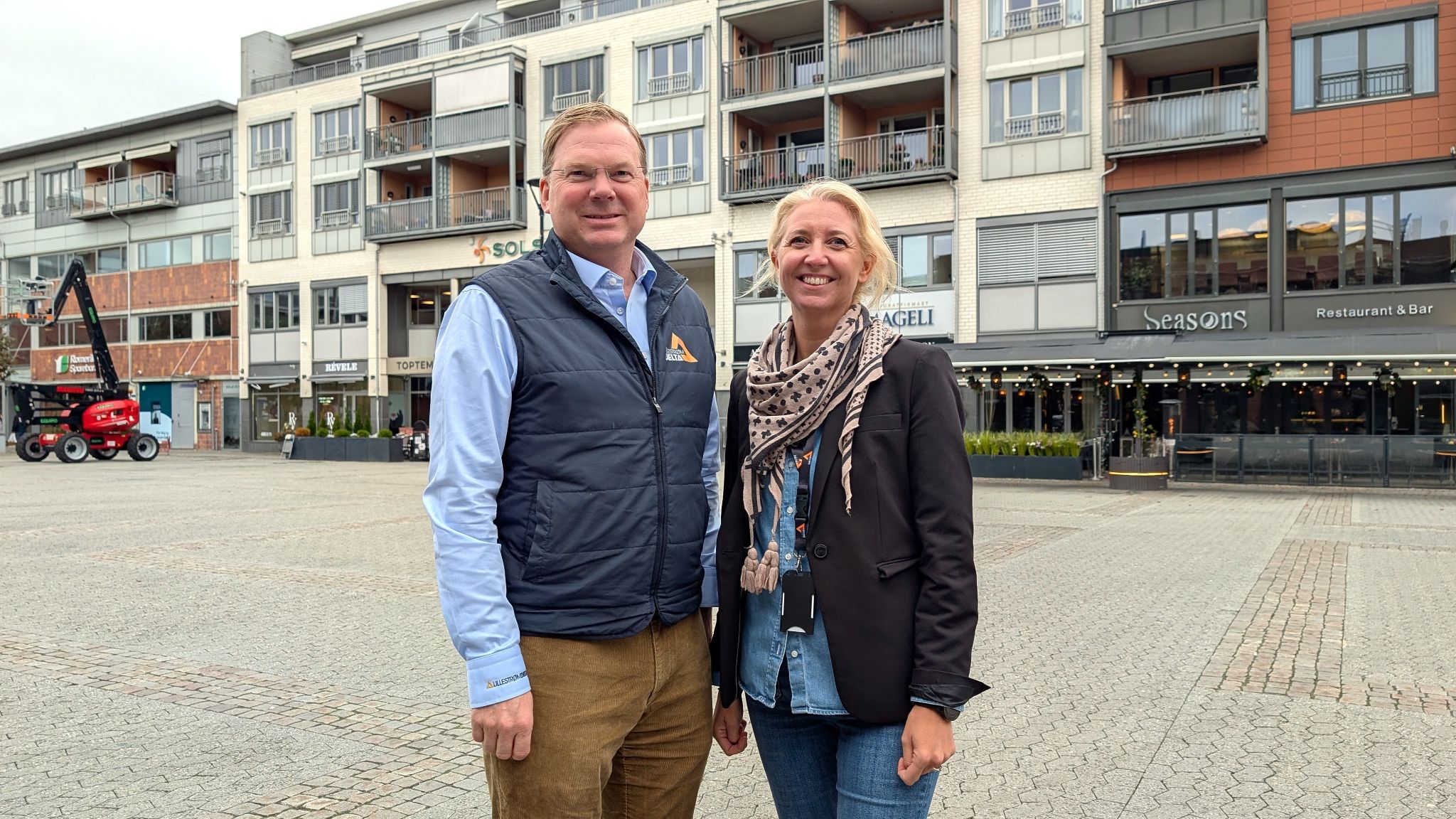
Rolf Th. Holm and Charlotte S. Bergerud, CEO and Administrative Manager at Lillestrøm Delta, are committed to securing the buildings they manage so that tenants are as well-equipped as possible to carry out their daily operations during a crisis.
Can we keep our business running during a crisis? This is, in fact, the most important task for the business community when unexpected events threaten us.
Whether it is natural disasters, technological collapse, or in the worst case, war, it is crucial to maintain as much normality as possible – and ensure that everyday activities can continue, points out Ketil Matvik Foldal, Head of Emergency Preparedness in Lillestrøm Municipality.
"Keeping the wheels turning is the most important contribution the business community can make," the Head of Emergency Preparedness emphasized when addressing the Kunnskapsbyen executive network in early September.
Taking responsibility for own operations
Rolf Th. Holm, CEO of the real estate company Lillestrøm Delta AS, says that security and emergency preparedness have received much greater focus in recent years. He himself is putting much more effort into the fundamental security of the company's buildings.
"This covers everything from locking systems, camera surveillance, secure networks, operational procedures, and access control. This is also something tenants are asking for," says Holm.
Lillestrøm Delta has tenants who practice for cyberattacks and how to handle a crisis.
"Our job is to ensure that operations can continue in the buildings we manage, so that tenants can carry out their daily business without hindrance."
Must preserve everyday life in a crisis
During the Kunnskapsbyen executive network meeting in early September, the Head of Emergency Preparedness drew a comparison to the municipality's responsibility for security and preparedness in a crisis. He explained that 95 percent of the effort will go into maintaining municipal services throughout the crisis, so that everything from schools, kindergartens, and health and welfare services to building permit processing can keep running.
"Only five percent is about extraordinary measures such as evacuation, building flood barriers, mass vaccination, distribution of iodine tablets, public alerts, or assistance to emergency services," said Foldal.
Rolf Holm felt it was reassuring to hear from the municipality that the business community's main focus should be to continue with their everyday operations.
"We have nevertheless discussed and made plans that extend beyond that," he says.
With the spirit of community effort that Norway can mobilize, Holm is convinced that the business community will step up and contribute what they can if a crisis were to occur.
"Even though there is no concrete plan for small and medium-sized enterprises, as there is for larger companies, this part of the business community represents a quite large network that will be utilized."
Need a robust business community
This is in line with the expectations the municipality has for the business community. Companies must be there and "fill their role," even when things get tough.
To be prepared, companies must map their risk and threat landscape – and do what is necessary to maintain operations through various stresses by envisioning different scenarios, such as: "What happens – what do we do?"
The emergency preparedness manager highlighted some scenarios that should be planned for:
- Loss of power and internet
- Absence of employees who have been called up for service
- Lack of access to raw materials and fuel
- Cut off from customer contact
In such cases, companies must be flexible and look for opportunities, points out Foldal.
Together for total preparedness
The Romerike Declaration for total preparedness was signed this summer by a number of municipalities, knowledge hubs, and companies during Arendalsuka.
Read more about this in the article "Romerike as a national emergency preparedness arena"
The declaration, which was initiated by Kunnskapsbyen, is based on a simple core:
- Preparedness is built before the crisis hits
- We must know each other before we need each other
- And we must understand the risk, practice together, and learn together
– The network is open to more partners. Even though we are well-structured to create a national learning arena, we are happy to invite new ones to join, says General Manager of Kunnskapsbyen, Inger-Lise M. Nøstvik.