

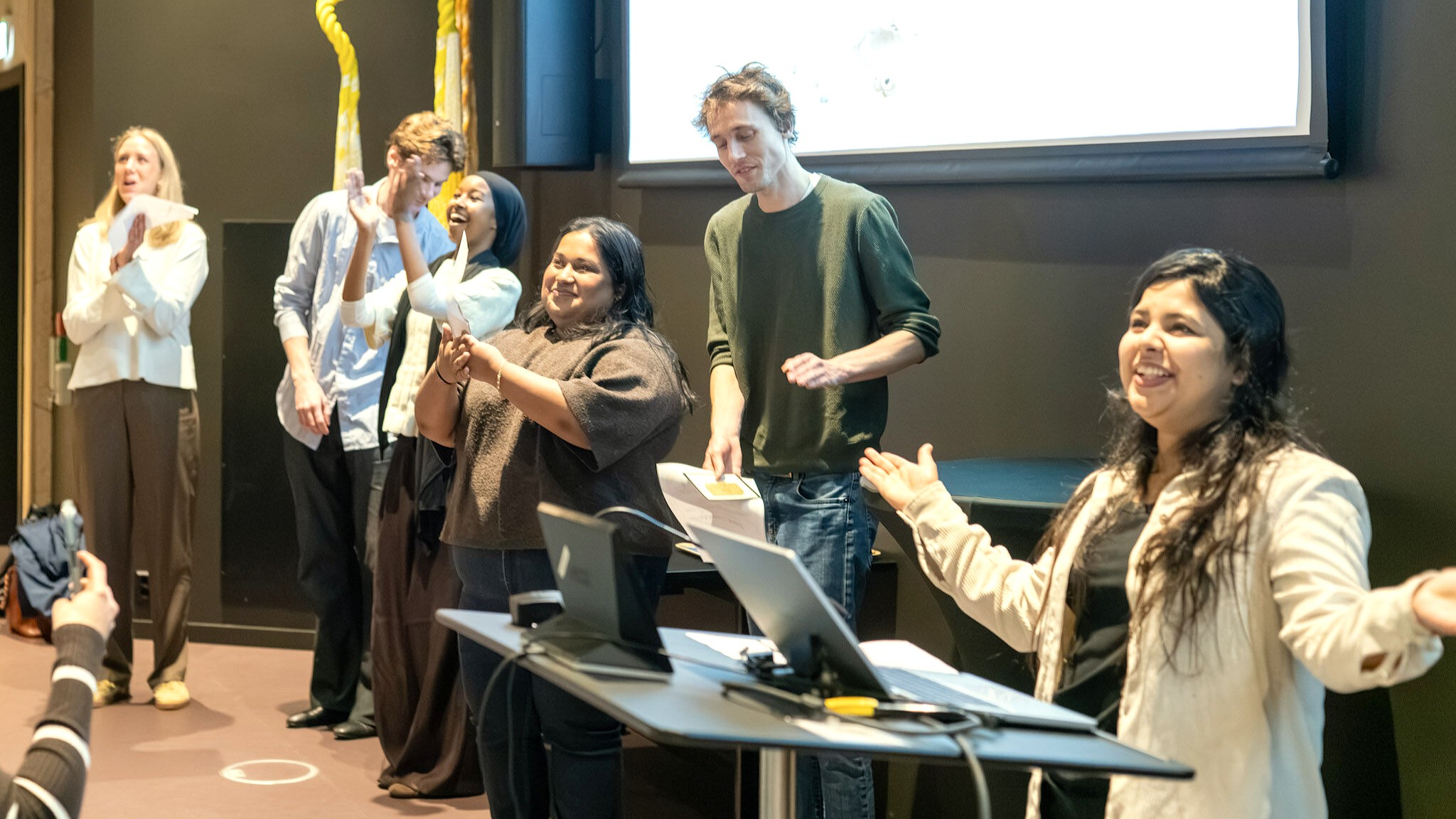
During the pitch competition at Oslo City Hall, the winners presented a solution that makes it easier for patients with cognitive challenges to navigate Sunnaas Hospital. Photo: Stian Jessen, OsloMet
After two intensive days of collaboration, creativity, and problem-solving, the winners of this year's HealthHACK have finally been announced.
HealthHACK is OsloMet Intelligent Health's hackathon for health technology. Here, interdisciplinary student teams of 5-6 people develop solutions to real, unsolved challenges in the health sector, proposed by our partners.
The participants met for a pitch competition at Oslo City Hall, where they were welcomed by the City Commissioner for Health, Oluf Ulseth, before presenting their solutions to the jury.
The event was hosted by OsloMet's initiative, Intelligent Health. Professor Vibeke Telle-Hansen was thrilled by the students' tremendous efforts.
– All the participants have truly impressed us with their dedication, creativity, and ability to execute, she says.
Solved a practical problem
This year, the students worked on challenges from the City of Oslo, Lillestrøm Municipality, Rælingen Municipality, and Sunnaas Hospital.
OsloMet students Ramlah Mohamud, Elisabeth Fure Schwarz, Thamara Jeyarajh, Pary Das Gupta, Joel Pallin and Brage Lindebrekke won with their solution for how patients with cognitive challenges can more easily navigate Sunnaas Hospital.
In a short amount of time, they developed innovative proposals for technological solutions that can help address challenges in health and care services.
Enthusiastic jury
Rælingen's municipal director Eivind Glemmestad and Lillestrøm's municipal head of health and institutions, Marita Kolstrøm were among the members of the jury, which was led by NODE60's project manager Even Sand. He is also full of praise for the students' enthusiasm. He also commends the organizers for excellent facilitation.
– An event like this doesn't happen by itself, says Sand, who extends a big thank you to everyone who has contributed.
The event was led by OsloMet's pro-rector Carl Christian Thodesen. He points out that the opportunity to build networks, share knowledge, and collaborate across disciplines, educational institutions, and sectors has been at least as important as the competition itself.