

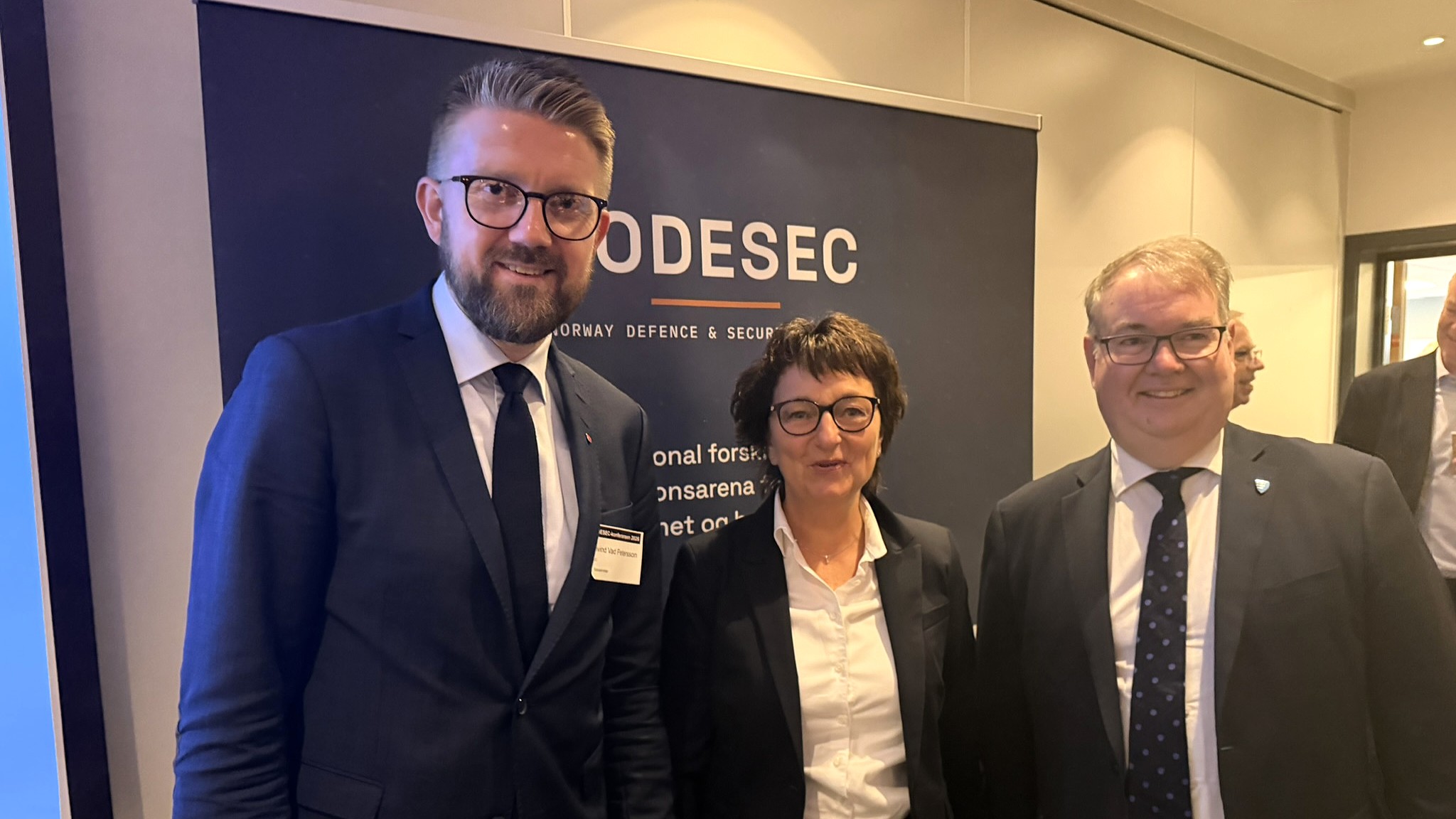
The government participated in the NODESEC conference with State Secretary at the Ministry of Foreign Affairs Eivind Vad Petersson (Labour Party), pictured here with the CEO of Kunnskapsbyen, Inger-Lise M. Nøstvik, and the Mayor of Lillestrøm, Kjartan Berland (Conservative Party).
How should Norway work to accelerate the strengthening of our resilience? NODESEC (Norway Defence and Security Centre) has taken action – bringing together stakeholders from research, industry, and the defense sector.
At NODESEC, municipalities, businesses, and knowledge communities are pulling in the same direction, noted Lillestrøm Mayor Kjartan Berland in his opening speech at the conference. This gives cause for optimism, he added.
"In a time when many talk about vulnerability, we choose to build strength. In a time marked by uncertainty, we choose cooperation. And in a time when challenges are growing, we choose to face them together," said Berland.
NODESEC's vision is to be Norway's leading innovation arena for technology that strengthens defense, security, and emergency preparedness. With the war in Ukraine, a more complex threat landscape, digital attacks, and increased geopolitical rivalry as the backdrop, security and preparedness cannot be taken for granted.
"Norway needs NODESEC," stated Kenneth Ruud, Director General of the Norwegian Defence Research Establishment (FFI), during the opening of the very first NODESEC conference at Kjeller on September 24. He pointed to the need for a cross-sectoral arena for defense and security-related research and development, noting that NODESEC represents the entire chain: from research, through startups and industry, to operational use.
Must practice cooperation
There is an urgent need to build up the country's resilience. New threats can emerge within a few weeks. Countermeasures can become outdated just as quickly.
This race is not just about technology, but also about who is invited to participate. Kristian Enger, Regional Director at NHO Viken Oslo, reported that six out of ten companies want to contribute more to emergency preparedness. The willingness is there, but only one in three feels they are part of the preparedness effort.
The Kjeller institutes possess the expertise and infrastructure. They also have experience in handling both classified and open research and development.
NODESEC aims to strengthen the interaction between industry and research, with the goal of:
- Reducing the time from idea to operational capability
- Strengthening Norwegian sovereignty in critical technologies
- Making Norway a more attractive ally
Building on local advantages
Mayor Berland does not see it as a coincidence that the Norway Defence and Security Centre is being established specifically at Kjeller.
"The expertise communities built up at Kjeller have contributed to solving important societal challenges, strengthening Norwegian competitiveness, and developing technology with significance far beyond our own region."
At the same time, he also pointed out that NODESEC is about more than just security: "It is also about development. About jobs. About competitiveness. And about making Lillestrøm and Romerike an even stronger knowledge hub for Norway."
Inger-Lise M. Nøstvik, CEO of Kunnskapsbyen, points to the lessons from Ukraine regarding how rapidly technology evolves and how crucial close collaboration between operational units, research institutions, and industry is. For her, this was the most important takeaway from the NODESEC conference.
– If Norway is to become an even more attractive and relevant ally, we must not only invest more. We must also become better at collaborating, testing, scaling, and adopting new solutions more quickly.
Taking national responsibility
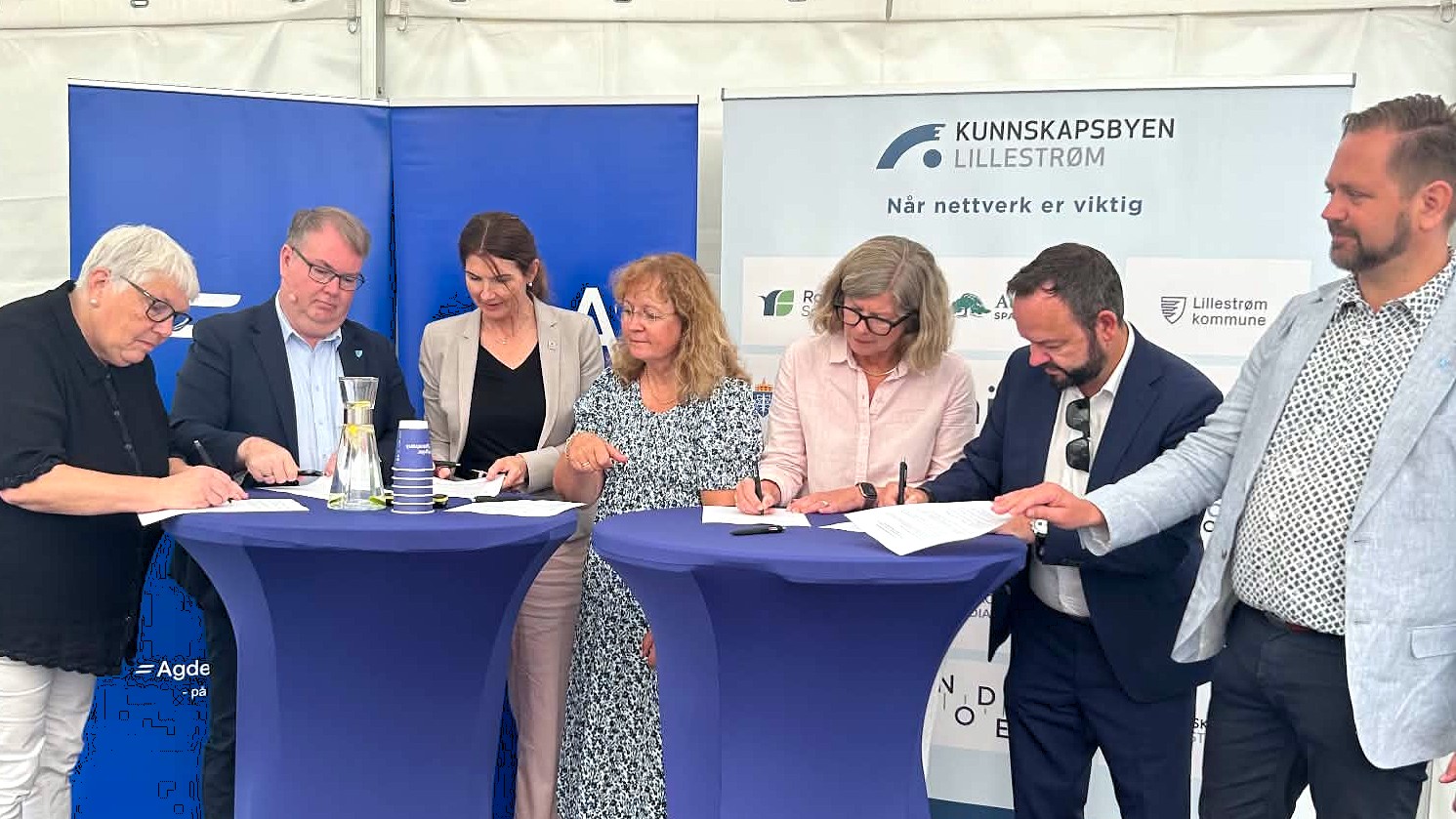
Mayor Berland also highlighted the Romerike Declaration for Total Preparedness, which he is proud that Lillestrøm Municipality helped establish. The declaration unites municipalities, the business community, and knowledge hubs around a shared ambition to make Romerike a national arena for total preparedness, exercises, learning, and innovation.
Few regions have the same prerequisites as Romerike, with municipalities, research institutes, technology companies, energy sectors, financial institutions, critical infrastructure, and logistics hubs gathered in a small geographical area.
– That gives us a special responsibility, but also a unique opportunity, said Kjartan Berland.
NODESEC was established by The Norwegian Defence Research Establishment,Institute for Energy Technology,NORSAR,NILU,Justervesenet,Kunnskapsbyen and Kjeller Innovasjon. The initiative is anchored in the NODE60 innovation district, which brings together business, academia, research environments, and the public sector into a shared ecosystem, with the goal of contributing to solutions for some of the greatest challenges of our time.