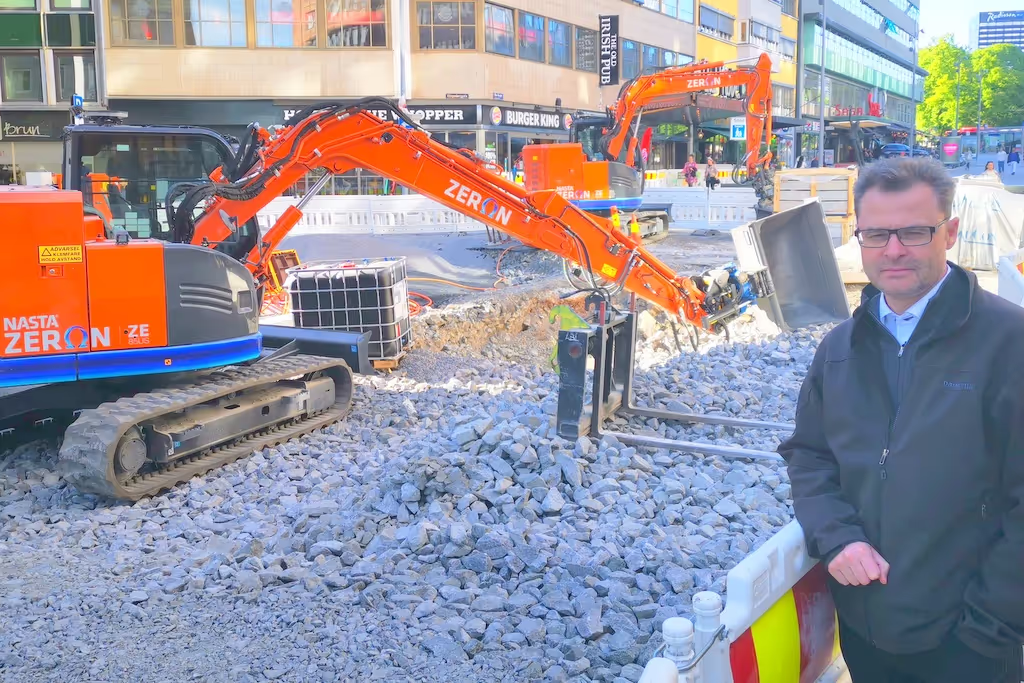




A year ago, Gothenburg began developing procurement requirements to accelerate the construction sector's transition to emission-free construction sites. The recommendations are now in place.
The article is primarily sourced from Business Region Göteborg
"Both suppliers and clients now feel confident enough to take the plunge and demand emission-free contracts," says Anastazia Kronberg at Business Region Göteborg.
Today, construction machinery accounts for approximately 20 percent of the transport sector's greenhouse gas emissions, and according to forecasts, this share will increase to 50 percent by 2050 if no action is taken. Cleancon's partner, Göteborgs Stads Leasing AB, has participated in the "Emission-free construction sites" project in collaboration with all of the city's building administrations and companies.
The purpose of the project, funded by the Swedish Energy Agency, has been to develop common procurement requirements to accelerate the construction sector's transition to emission-free construction sites.
Cleancon's Norwegian project owner Kunnskapsbyen Lillestrøm, represented by project manager Jon Eriksen, participated in the market dialogue organized within the framework of the project, where client organizations, politicians, manufacturers, and contracting companies took part.
"The project has been inspired by the work in Oslo, where a completely emission-free construction site is being implemented on Olav V's gate and Klingenberggata, which helps accelerate technological development," says lead project manager Anna Cornander at RISE.
First pilot project launched
Several participants in the initiative will now test and develop the requirements in their own procurements. Gothenburg Port is the first to rigorously test the requirements. Dirk Wallem is a procurement officer and has also been involved in developing the requirements.
"Being a pilot in this project aligns perfectly with our goal of being the most competitive port in the world, and to achieve that, we must lead the way in certain areas. It's very exciting to test these requirements and conduct such a procurement, even though it naturally demands more resources from both our purchasing department and project management. But we are the driving force in many areas of the city, and we intend to remain so, says Dirk Wallem.
– I believe Gothenburg residents will be able to see the first quiet and emission-free construction machinery in the city as early as 2021, says Anastazia Kronberg, operations manager for Gothenburg Climate Partnership, at Business Region Göteborg.
A Catch-22
At the beginning of the project, a current state analysis and a market dialogue were conducted, involving client organizations, politicians, manufacturers, and contracting companies. It was quickly identified that development risked stagnation due to a perceived Catch-22.
"The market didn't perceive a demand from clients for emission-free construction machinery, meaning machines powered by electricity or hydrogen. Conversely, clients saw no supply of these types of machines," says Anastazia Kronberg.
However, it was felt that both suppliers and clients were eager to get started, and everyone agreed that benefits in terms of market profitability, climate gains, and a better local environment for residents and visitors were on the horizon if the transition succeeded.
Requirements that facilitate the transition
The project has developed five requirements, each suitable for different projects and adaptable as the market matures. These requirements mean, for example, that a certain percentage of machines, work processes, or energy consumption must be emission-free. Another possibility is to design the evaluation model so that bidders describe how they plan their work to reduce emission levels in the specific contract, which can then provide added value weighted in the evaluation.
Throughout the project, the market has provided input on the necessary conditions. Among other things, requests have been made for the client to ensure and be responsible for electricity and charging infrastructure at the construction site, for longer lead times between contract signing and project start, and for the requirements to be followed up.
"The project has increased our knowledge as procurers of emission-free work machines, which means we are now in a position to demand higher standards. It is also important that, in our role, we continue to actively participate in the process to drive development forward and address the issues from a procurer's perspective," says Malin Östblom, environmental strategist at the Traffic Administration in the City of Gothenburg.