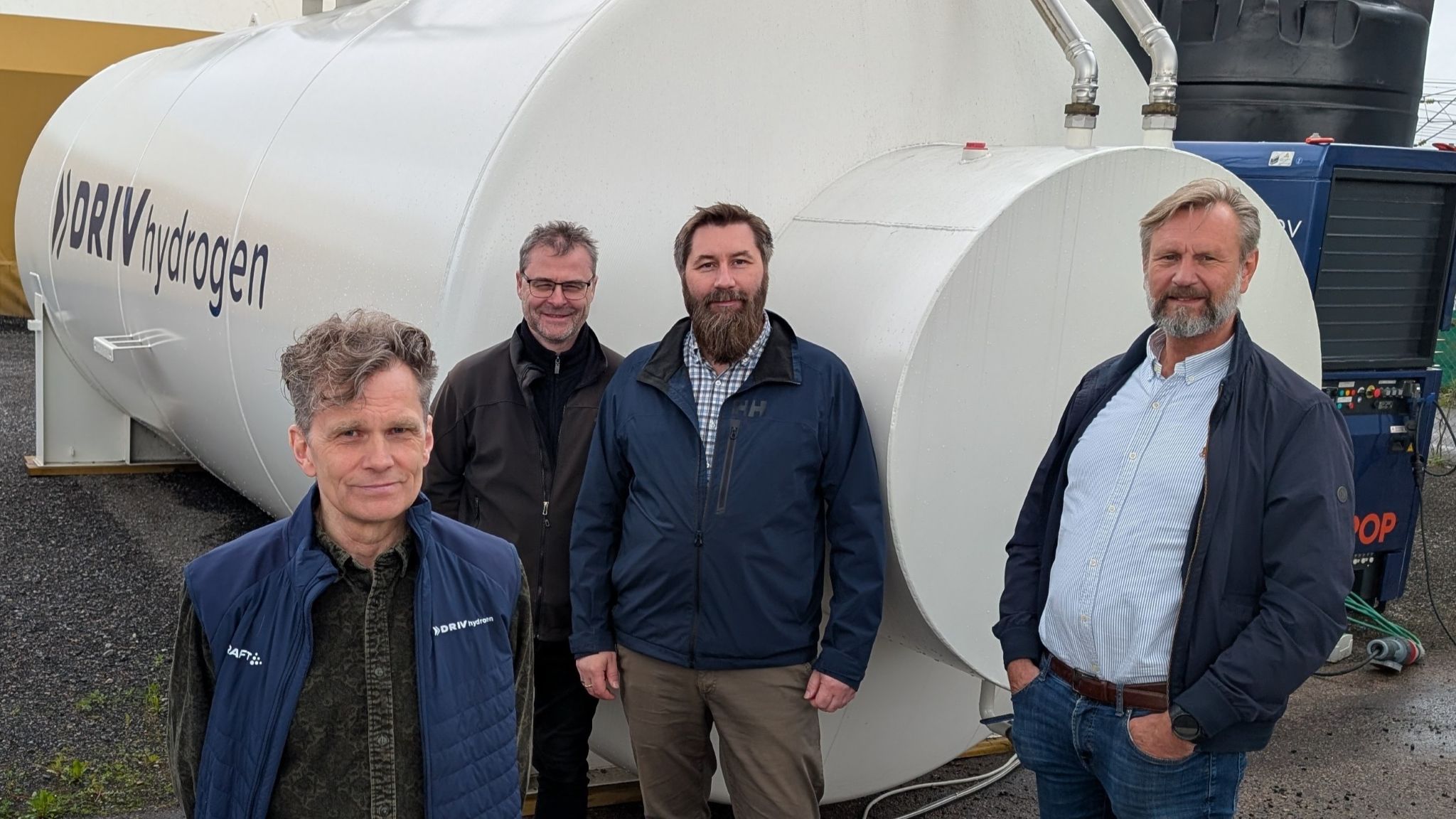
NAPOP's Operations Director Aage Bjørn Andersen, Kunnskapsbyen's Project Manager Jon Eriksen, NAPOP's CEO Terje Paulsen, and Akershus Energi's Business Developer Frank Sagvik are collaborating on emission-free energy solutions and contingency planning in the NODE60 innovation district.
Hydrogen company NAPOP is Node60's new, green contingency resource. The company can provide energy security to businesses in the district.
NAPOP is the innovation district's newest partner. With its unique green platform, the company provides both energy security and effective climate solutions for the district's future business community.
By combining CTC technology (catalytic hydrogen oxidation), balancing market participation, and hydrogen as a contingency resource, NAPOP creates an ecosystem where industry and natural resources collaborate in an emission-free energy system.
Today, the process industry is largely dependent on fossil energy sources, which presents significant emission challenges. With NAPOP's hydrogen technology, the industry has gained a fossil-free alternative that can eliminate this dependency.
Four key areas
NAPOP's contribution to Node60 follows four main tracks:
- Energy Balance: Instantaneous connection and disconnection of power to the balancing market and stabilization of the grid in the district
- Contingency: Hydrogen contingency resource and critical solution for emission-free emergency power generators
- Fossil-Free Alternative: "CTC" as a replacement for fossil fuels (with emission recovery from hydrogen production)
- Resource Utilization: Surplus power from solar park produces hydrogen for storage, with oxygen as a byproduct, sold to fish farming
Emergency Resource
One of NAPOP's most important contributions to Node60 is to highlight hydrogen as an emergency resource.
"When data centers in the district are to become emission-free, there must be a requirement that traditional diesel emergency power generators are replaced with emission-free solutions. NAPOP can deliver such a solution, based on hydrogen," says NAPOP's Operations Director Aage Bjørn Andersen.
In addition to being environmentally friendly, the solution is also economically sustainable, he points out. By using surplus power from solar parks to produce hydrogen for storage, a circular value chain is created in the energy market. Solar energy triggers an ingenious value chain:
- produces hydrogen by electrolysis when there is surplus power
- the hydrogen is stored as a backup for emergency power and for industrial use
- hydrogen and battery-stored solar power can cover heavy load demands
- oxygen, which is a byproduct, as well as surplus heat from production, can be sold to health, aquaculture, and industrial players
Look to Kløfta
With its participation in Driv hydrogen's new preparation facility for hydrogen tanks at Kløfta, NAPOP has proven that the technology works.
New hydrogen tanks are always filled with nitrogen before they enter the market. All the nitrogen must be removed before the tanks can be used for hydrogen. The facility at Kløfta is the only one of its kind capable of "washing out" the nitrogen – without climate emissions.




.avif)


.avif)