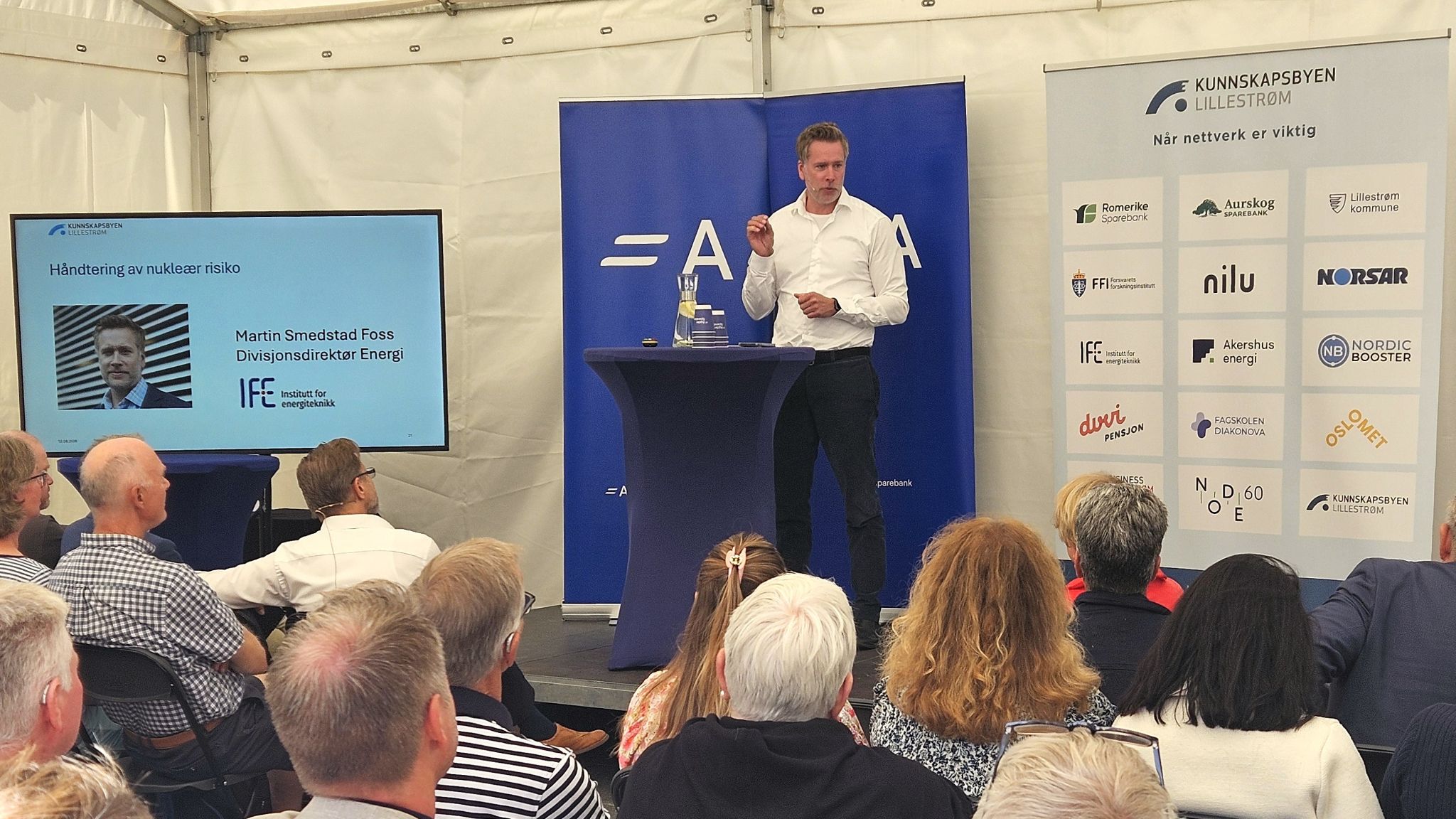
The Institute for Energy Technology has extensive experience in handling nuclear threats, said Martin Smestad Foss, Division Director for Energy. Photo: Jon Eriksen
Municipalities with experience from past crises, businesses that are quick to adapt, and a sharp scientific community. Romerike is well-positioned to face the next crisis.
The complex risk and threat landscape we are currently facing makes collaboration between the private sector, the public sector, research institutions, and the voluntary sector more important than ever.
So, what do we actually do when a crisis hits?
That was the setting when Kunnskapsbyen and NODE60 hosted the event "Emergency Preparedness: Learning from Real-Life Events" at Arendalsuka.
– Keep the wheels turning
Seven speakers shared their experiences from real-life crisis situations. Their clear message was: "Practice, practice, practice," get to know each other, and establish effective communication channels.
Member of Parliament and long-time former mayor of Lørenskog, Ragnhild Bergheim, pointed out that training also makes us better equipped for crises we haven't specifically prepared for, by teaching us how to identify and utilize the resources available on-site.
NILU's CEO Tomas Eric Nordlander put it this way: – Crises don't follow a script and require many people to find each other quickly, which is much easier if you already know one another.
In a crisis situation, it is important to keep the wheels turning and maintain as much normalcy as possible, noted the emergency preparedness manager in Lillestrøm municipality, Ketil Matvik Foldal. He points to Ukraine, where they keep schools open and continue operations as usual, as far as possible.
– Talk to each other in advance
Effective communication lines are crucial in a crisis situation, explained Mayor Karl-Arne Johannessen, who spoke about the quick clay landslide in Gjerdrum. They experienced receiving an enormous amount of help from the outside.
The mayor does not, however, hide the fact that the municipality faced a challenge with the lines of command in managing the relief efforts, with large, incoming resources. The municipality had not accounted for this in its crisis plans.
When a crisis occurs, it is important to have a clear division of roles, pointed out CEO Øivind Askvik of Akershus Energi. In January two years ago, 60 people had to be evacuated in nearly 20 degrees below zero, when a power cable failed and a fault occurred in the backup cable deep in the frozen ground.
It took some time to get the municipality on board to help the residents evacuate. The municipality assumed that the grid company, which had its hands full repairing the power cables, would also take care of the residents.
Research as a crisis resource
Ahead of the event, several municipalities, research institutes, banks, and companies had joined forces to sign the "Romerike Declaration for Total Preparedness". The partnership aims to develop the region as a national test and learning arena for total preparedness.
Romerike has, among other things, extensive experience in handling nuclear threats. The Institute for Energy Technology (IFE) has long experience and leading knowledge regarding this risk, explained Division Director for Energy, Martin Smestad Foss.
Within a concentrated area at Kjeller, the research community has nuclear research, facilities for seismic monitoring, and atmospheric modeling. These are facilities that civil society benefits from greatly.
In a crisis situation, NILU can create dispersion maps that show the spread and movement of radioactive particles. The institute is even able to track ash clouds from volcanic eruptions, which are difficult to trace on weather radar, providing great assistance to flight safety.
– Use each other's resources
NORSAR's Deputy Director Arve E. Mjelva, who is also the Head of Security and Preparedness, demonstrated how measurements through existing fiber infrastructure can be used to monitor large areas. A standard fiber optic cable in the ground can function as a sensor along its entire length. The technology can be used to monitor critical infrastructure, border areas, quick clay and landslides, and traffic.
Romerike has both a foundation of experience and unique expert resources to be able to handle almost any crisis in a good way, points out the General Manager of Kunnskapsbyen, Inger-Lise M. Nøstvik. But even here, there is potential to establish even better channels for collaboration.
– Preparedness isn't created when a crisis strikes. It is built through knowledge, practice, and collaboration over time. We don't know where or when the next crisis will come, but we do know that it will test our ability to work together, she says.