
.avif)



Practical implementation
Examples of emission-free plant operations
Emission free working machines
Grønne innkjøp
Financial support schemes
Tools and calculators
Background fabric
Life Cycle Analysis (LCA)
In general
Life cycle analysis (LCA) is a method for calculating the environmental impact throughout the life cycle, starting from”cradle to grave”, or preferably”cradle to cradle”. That is, the extraction of raw materials, production, transportation, use phase to the disposal or reuse of a product or service. A life cycle analysis can show which environmental impacts are greatest, what is the background to these and which phase of life is most important in relation to different environmental stresses.
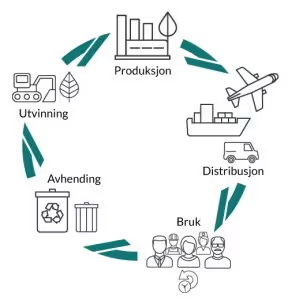
Tools for an LCA analysis
Analyses done in tool SimaPro, can provide information on which requirements are relevant when calculating environmental loads in a procurement. LCA does not involve any cost calculations.
System limit
To get a good lifecycle analysis, one must define system boundaries. It is defined in how detailed the product system is to be studied, and which emissions are evaluated. It is important to provide a justification if one excludes any processes or data. The data available for analysis may be limited in that, for example, one does not have data for a particular product, but an average data for a corresponding product.
When defining system boundaries, you sometimes have to cut through, otherwise the level of detail can become very extensive. Often you may want to define a cut-off criterion; for example, ignoring all components that contribute less than 1% of total emissions. Other important system boundaries that should be included are geographical boundaries (should one include mass transport to and from the construction site or passenger transport?) and time (what year does the data come from?).
Learning Outcomes in Electrification of Working Machines
In the SINTEF report”Zero Emission Excavator: Learning Outcomes from Electrification of Construction Machinery” DFØ, among other things, has documented a life cycle cost (LCC). It includes both acquisition, operating and maintenance costs. The LCA was used to quantify the environmental impacts of a 17.5 t diesel excavator and a 17.5 t electric excavator, with the aim of documenting and comparing greenhouse gas emissions between the two options. The LCA results show a greenhouse gas emission reduction of 84—94% from conversion of a 17.5 t diesel to a 17.5 t electric excavator. The results for the diesel excavator show that the greatest environmental impacts come from diesel consumption in the operation and production of the excavator. The results for the electric excavator show that greenhouse gas emissions also take place in the conversion process (batteries, electric motor and inverters) as well as installation on the construction site (container and cable).