.avif)



Practical implementation
Examples of emission-free plant operations
Emission free working machines
Grønne innkjøp
Financial support schemes
Tools and calculators
Background fabric
Emission-free construction site: Lystad fire station in Lillestrøm municipality
Lystad Fire Station was laid out as a green procurement where it was environmentally competitive on the level of emission-free. The fire station is Lillestrøm municipality's pilot in terms of using emission-free work machines in an active construction project. The start of construction was in August 2021 and The official opening of the new fire station took place on 1 September 2023.
The construction project was carried out as the municipality's demo project in Interreg project Cleancon.
The municipality of Lillestrøm received seven offers for its call. It was very gratifying to see that the market responded so positively to compete on the level of emissions-free already at the call in 2021, a relatively complex construction site was provided, which a new fire station actually is, and that the project also included the repair of existing intersections and the construction of an access road to the station from county road. In addition, new infrastructure and VA facilities were to be constructed and detailed designed.
The building has been established with green roofs as part of the stormwater concept for the property, as well as solar cells being installed on parts of the roof of the carriage hall. Read more about the project on Doffin and at Nedre Romerike Fire and Rescue Service (NRBR).
Anchoring
In general, Lillestrøm Municipality is a partner NHO's Supplier Development Program (LUP) which intends to increase the innovation impact of public procurement. Its purpose is better and more efficient services, business growth and lower emissions. The programme assists municipal and state enterprises with innovative procurement and methods to achieve this, and where innovation in building and construction is in practice safeguarded through the municipality's Climate strategy and Green Procurement Strategy.
However, the use of emissions-free working machines was cost-driving, and the council's involvement in Cleancon was therefore important in terms of securing the necessary funding. When, in its time, the municipality of Skedsmo entered Cleancon, it was rooted in the political decision that participation in the Interreg project presupposes that the pilot project received the necessary funds to be able to carry out the construction project with the use of emission-free construction equipment. Furthermore, the CleanCon participation made it possible to get in touch with key people in the municipality of Oslo, and to gain experience from emission-free projects they had completed or in the casting spoon.
Experiences
Lystad Fire Station was Lillestrøm municipality's first experience with emission-free construction machinery. The project was environmentally ambitious without getting overambitious and thinking that all machine hours must be 100% emission-free. The important thing was to get started, acquire knowledge, gain experience, lay a foundation, and then take the next step in the next project. A significant challenge in the project was that the undeveloped plot where the fire station was to be built was located in a pig-lined area with only access to a weak net. This meant that the municipality opened up a combination of fossil-free and emission-free technologies, with the desire for as high a rate of use of emission-free machines as possible.
The chosen contractor offered essentially emission-free machinery and equipment, with the exception of an asphalt paver, drilling rig and an excavator that all ran on biofuel. Furthermore, the contractor wanted to have a focus on emission-free transport (trucks) to and from the construction site, although this was not a requirement in the competition. The challenge of fast charging of the electric excavators and the weak network in the area was solved by the adoption of a newly developed temporary container-based transformer and a mobile charging container adapted for construction machinery.
The reporting on the use of fossil- and emission-free machinery was made in writing by the contractor every month. There were no recorded deviations from the requirement for minimum fossil-free plant operation, but automated solutions for monitoring machine usage will undoubtedly greatly reduce management and ensure far better control over target achievement. A digital/live monitoring of machine use is therefore one of the most important learning points the municipality is looking forward to in the second project.
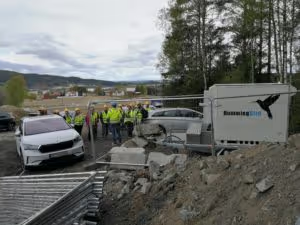
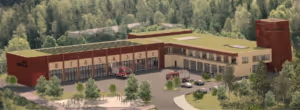
Environmentally ambitious Lystad Fire Station (Source: VindAS)