
.avif)



Practical implementation
Examples of emission-free plant operations
Emission free working machines
Grønne innkjøp
Financial support schemes
Tools and calculators
Background fabric
Life Cycle Costs (LCC)
In general
Life cycle costs (LCC) deals with all the costs that the employee tax generates throughout the lifetime. It includes investment costs and costs of management, operation, maintenance, development, as well as costs of disposal. The purpose of the LCC tool is to calculate which solutions or offers pay off when taking into account the total costs.
DFØ's tool for calculating LCC
The Directorate of Management and Financial Management (DFØ) has tools for calculating life cycle costs. Using the spreadsheets, you can plan, evaluate and track the total cost of a purchase, including for a car and a floor washer.
The procurement authority's tool for calculating the LCC
The Procurement Authority (UHM) has created a general tool for LCC calculations. You can get an idea of how big the real cost of a product or service will be during its useful life. Read more about LCC tools here.
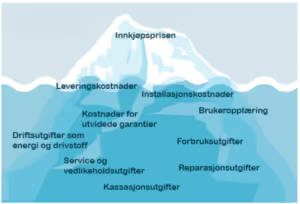
Procurement cost and operating cost
The new emission-free machines are often more expensive to purchase than current diesel-powered machines. Over the life of the machine, however, the purchase cost will make up a smaller portion of the overall cost picture. If costs are included throughout the life cycle of the machine, the cheapest option will often also be the one that is best for the environment. This is due, among other things, to the fact that the emission-free machines require less maintenance, are more energy efficient and use cheaper fuel.
Example
In the SINTEF report”Zero Emission Excavator: Learning Outcomes from Electrification of Construction Machinery” DFØ has documented, among other things, a life cycle cost (LCC), which includes both acquisition, operation and maintenance costs.
The results show that the largest cost of the diesel excavator is operating costs, followed by acquisition costs, maintenance costs and other costs. For the electric excavator, acquisition costs are highest followed by other costs, residual value, operating costs and maintenance costs. The results show that the electric excavator has higher acquisition costs than diesel, but lower operating costs. After a 10-year period, it was concluded that an electric excavator can be more competitive than a diesel-powered excavator. The advantage of electric solutions will strengthen even more when the purchase price and battery price of electric excavators are reduced and when it is produced in larger series.